


Johannes Ketterer, COO and CSO at SCHUNK, explains how SCHUNK understands and develops the customer relationship and how it puts the relationship into effect.
Mr. Ketterer, why is the focus on customer requirements so important for SCHUNK?
In the past, we pursued a universal approach: one product for many customers in different markets. Today, however, we are operating in a more specialized world in which it is crucial to adapt our service portfolio precisely to the requirements of each individual customer.
In order to position ourselves in a differentiated way, it is essential that we understand our customers and speak their industry-specific language, be it in life science, electronics, automotive, aviation, or defense. And we want to understand the needs of the individual: the buyer, the designer, the commissioning engineer. This is the only way we can provide the greatest possible benefit for our customers.
You also maintain many partnerships. What significance do they have?
A very great significance! Partnerships are a fundamental prerequisite for long-term success. We therefore rely on close cooperation with universities, research institutes, and companies in order to continuously expand our technological expertise and shorten innovation cycles. We maintain partnerships along the entire vertical value chain, including upstream and downstream process steps. One example of this is our cooperation with integrators, with whom we offer shared solutions. We are also continuously developing our supplier networks into strategic partner networks. On the one hand, to create the innovations of tomorrow, and on the other, to meet the increasing demands for speed in product development and delivery times. By pooling our strengths, we ensure that we remain agile and efficient.
How have customer requirements changed over the past few years?
The importance of speed has increased significantly in recent years. As Heinrich von Pierer aptly put it: “The big don’t eat the small, but the fast overtake the slow.” This principle shapes our strategic direction: we focus on agility and speed in order to always be one step ahead for our customers. At the same time, customers increasingly expect solutions at process level, not just at functional level. For us, this means that we can not only provide the ‘gripping’ function, but also deliver productivity along the entire ‘handling’ process. The art of paring things down to the essentials has also gained in importance. That’s why we provide the exact function that the customer needs for a specific application. These overarching trends are reflected in different priorities: sometimes the focus is on speed, sometimes on a particularly lean solution.
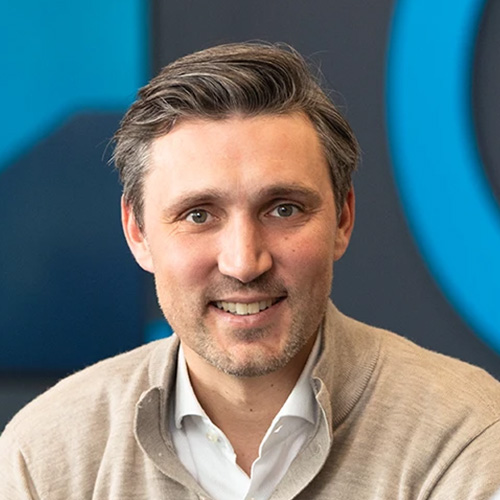
“At the end of the day, it is people who live and embody our corporate values. Personal customer relationships are the basis for creating joint innovations.”
Johannes Ketterer, COO/CSO | Member of the Management Board
What conditions do you create to ensure that the customer experience is as positive as possible?
We are grateful to have been a reliable partner for our customers for 80 years and to be able to draw from a wealth of experience. This reliability at various levels is the be-all and end-all: we keep our promises. We also promise that what SCHUNK delivers is state of the art. As a technology pioneer, we always strive to remain a leader in our field in terms of our technological expertise and the performance of our products, systems, machines, and services. This reliability creates trust: in the brand, in the company, but above all in the people. At the end of the day, it is people who put our values into effect and transport them. Personal customer relationships are the basis for creating joint innovations and mastering new market requirements. Instead of investing in short-term success, we always invest in long-term customer relationships.
Is that enough?
No. Our aim is to make working with us as efficient and straightforward as possible. For example, a fully automated global ordering process. Our aim is to continuously expand our customer portal with digital services to make product searches, configuration, and ordering as easy as possible. The customer should therefore be able to find the right solution as easily as possible, even with a larger and increasingly complex portfolio. Our aim is to drive projects forward together with our customers in an integrated and collaborative process.
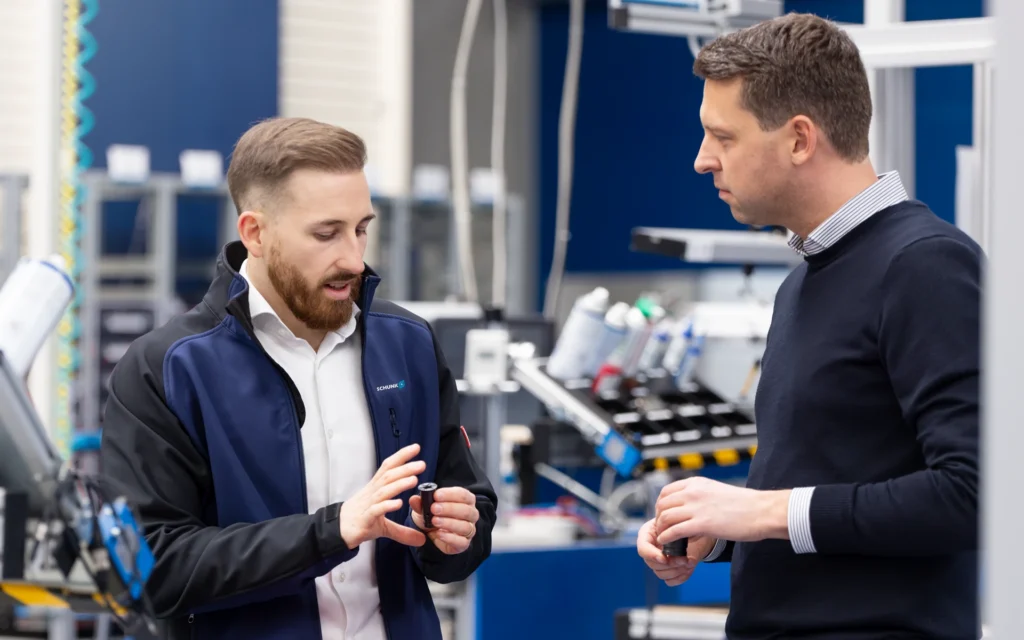
Can you give us a specific example to illustrate this?
I can give two examples that illustrate all the topics I have mentioned: the 2D Grasping Kit, an AI-supported handling solution, goes beyond the function of a simple gripper, and instead offers a comprehensive solution for the task at hand: gripping. We have designed the system’s user interface to be so intuitive and simple that an end customer is able to commission the system within half a day and automatically handle a diverse portfolio of workpieces. And the second example? This is the RCG round cell gripper for battery cells. This is where we put our decades of expertise with pneumatic gripping into effect, and we have developed it further specifically with the end customer: for handling round cells.
How do you manage to meet the different needs of your customers: from newcomers to the world of automation to those who are already well advanced and have special requirements?
First of all, this means understanding customer needs, clearly segmenting them, and adapting the service portfolio accordingly. Then, with our three steps to increasing productivity, we have an incredibly powerful tool to enable small and medium-sized customers to take the step towards automation. We offer SCHUNK Engineering for automation professionals. We use our broad technological expertise in gripping, handling, clamping, and changing to meet the challenges of large machine manufacturers and system integrators with jointly developed solutions.
What are the three steps to increasing productivity?
This enables customers to take the first steps towards automation very easily. A key pillar here is our consulting expertise. The first step involves a needs analysis by our experts. The focus is on whether an automation solution makes sense and, if so, what potential it offers. In the second step, we validate the technical feasibility. In one of our CoLabs, for example, we can map the customer’s processes in a workshop environment. Finally, we provide support during implementation, from the selection of suitable components to commissioning.
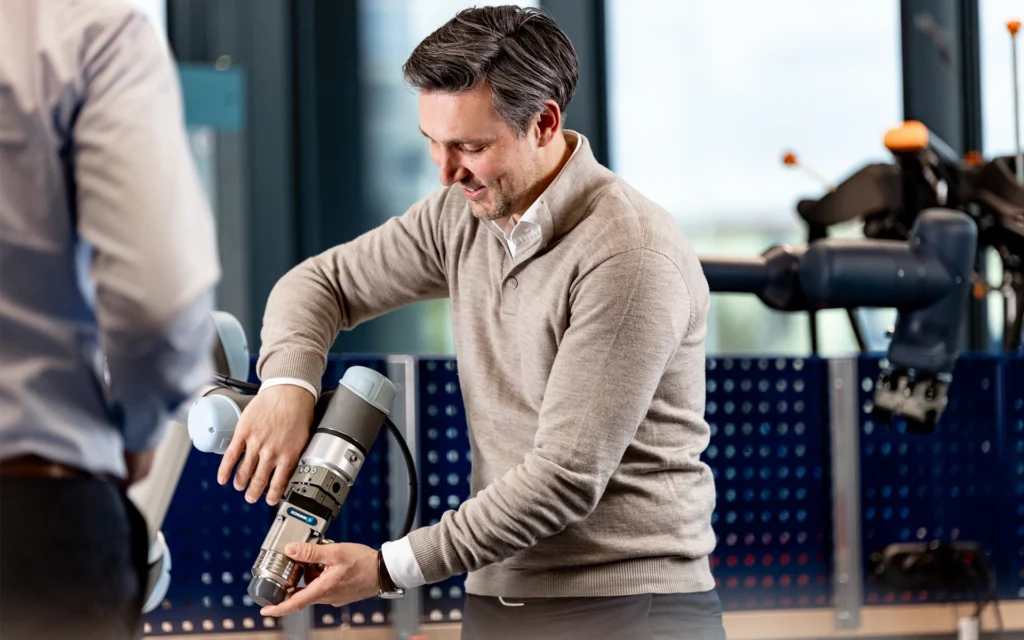
For Johannes Ketterer, CSO/COO at SCHUNK, the key challenge is to speak the customers’ industry-specific language and to understand the individual people.

SCHUNK is increasingly offering process solutions such as handling instead of pure functions such as gripping. This is in line with changing customer requirements.
What range of solutions can you offer through SCHUNK Engineering?
This starts with the use of standard components, but very quickly moves into the area of configurable components through to customized special solutions. We offer a comprehensive and modular engineering service that can be flexibly adapted to the individual requirements of our customers. Our range of services includes the design of sophisticated systems as well as their production, assembly, and commissioning directly on-site. We are able to develop and implement highly complex system requirements.
Where do you still see potential to improve the customer experience?
There is still potential for each of the topics discussed. The use of digital technologies – including artificial intelligence – still offers extremely high added value. We are continuously working to develop our global customer service and expertise to a uniformly high level worldwide.